How To Search for New Haven Property Records

You should always do proper due diligence before buying or investing in real estate. Reviewing property records is an effective way to do this. These records provide valuable insight into details like ownership histories, appraised values, tax obligations, zoning classifications, liens, and other information that can help buyers, investors, homeowners, and real estate professionals make informed decisions. Property records are considered public in New Haven, meaning anyone can view or copy them. The key is knowing where to look. Below is a list of resources that you can use to locate different types of New Haven property records.
New Haven City Clerk's Office

The New Haven City Clerk's Office records, processes, and maintains copies of mortgages, releases, quitclaims, liens, and other related documents that establish property ownership and interests in the city. The office provides a land records search tool that you can use to look up records online by name, document type, date range, and other criteria. You may also visit the clerk's office at Room 202, 200 Orange Street, New Haven, CT 006510 to search and obtain record copies in person (note: fees may apply) or call (203) 946-8339 for general inquiries and assistance.
New Haven Assessor's Office

The New Haven Assessor's Office is responsible for discovering, listing, and valuing all real property in the city for tax purposes. This office is a key resource for information on property ownership, market and assessed values, land and building characteristics, and sales history. You can access this information online using the city's property lookup tool; searches may be done by address, name, account number, and property ID. You may also visit the assessor's office at 165 Church St., New Haven, CT 06510 for in-person services or call the office at (203) 946-4800 for general information and inquiries.
New Haven Tax Collector Division
The New Haven Tax Collector Division is responsible for billing and collecting property taxes for the city. This office is the primary resource for tax-related property information, such as current and prior tax bills, payment histories, delinquency status, and more. The division provides access to an online tool that you can use to look up this information by name, property location, bill number, unique ID, or list number. You may also visit the tax collector division at 165 Church Street, 1st Floor, New Haven, CT 06510 for in-person services or call (203) 946-8054 for inquiries and general assistance.
Connecticut Superior Court

You can obtain records of property-related legal matters in New Haven, such as foreclosures, landlord-tenant disputes, and civil judgments affecting property titles, through the Connecticut Superior Court. The court provides a Case Look-Up tool that you can use to search these records online by name, docket number, attorney/firm juris number, or property address. You may also contact the chief clerk's office at the courthouse where the case was filed to access records in person (note: fees may apply). Here are the contact details for the courthouses located in New Haven:
-
New Haven Judicial District:
235 Church Street
New Haven, CT 06510
Phone: (203) 503-6800
Handles high-value lawsuits and complex issues of ownership, like foreclosures, title disputes, partition actions, civil judgments affecting title/use, and civil suits over $15,000.
-
Geographical Area 23 at New Haven:
121 Elm Street
New Haven, CT 06510
Phone: (203) 789-7461
Handles smaller-scale and localized cases, like lease enforcements, code violations, and most landlord-tenant disputes/evictions (through the specialized New Haven Housing Session).
New Haven Property Taxes

New Haven property taxes are a vital funding source for essential local government services such as public schools, police and fire protection, emergency response, community programs, infrastructure maintenance, and more. The New Haven Assessor's Office establishes the taxable value of properties in the city, while the Tax Collector Division handles tax billing and collection. Valuations are done using mass appraisal methods, and properties are assessed at 70% of their fair market value, meaning that taxes are calculated on only 70% of the property's estimated value. Once a property's assessed value has been established, local millage rates are applied to that value to arrive at its final tax bill.
Tax bills are typically mailed in late June. Taxes are generally due in two installments: the first on July 1st and the second on January 1st. However, bills of $100 or less must be paid in one installment. Payments are considered delinquent if not made within one month of the due date and begin accruing interest at 1.5% per month, starting from the original due date. You can pay your New Haven property taxes through several methods, including online, by mail, or in person at the tax collector division's office. You may call the office at (203) 946-8054 for additional information or assistance.
![]() Assessments
Assessments

The New Haven Assessor's Office conducts periodic assessments of properties in the city to determine each property's fair market value. Values are determined using mass appraisal methods that draw on three primary approaches: the sales comparison approach (reviewing recent sales of comparable properties), the cost approach (estimating land value plus replacement cost of improvements, minus depreciation), and the income approach (applied mainly to income-producing properties). Per Connecticut General Statutes § 12-62, the assessor's office performs a full city-wide revaluation of properties every five years to ensure that the tax burden is distributed fairly based on current market conditions. New Haven's most recent revaluation was in 2026; however, its next comprehensive revaluation is scheduled for 2032. Once a property's fair market value is determined, the state-mandated 70% assessment ratio is applied to arrive at its assessed value, which serves as the basis for calculating the final tax bill.
Property owners typically receive a notice of valuation change following a revaluation or if significant improvements are made to their property. These notices are usually mailed towards the end of November. If you disagree with your assessment, you may request an informal hearing with the assessor's office (or the company contracted to handle the revaluation) during a revaluation year. If the issue is not resolved by this, you can file a formal appeal with the city's Board of Assessment Appeals. This must be done on or before February 20th (unless an extension is granted). You can call the assessor's office at (203) 946-4800 for more information or assistance with the appeal process.
![]() Appraisals
Appraisals

New Haven assessments work similarly to appraisals. They both determine the fair value of property by comparing similar properties with others in the local area that have sold recently. In cases of odd structures or new construction, the county may call upon an appraiser to help determine the value. Estate planners, courts, and lenders also use appraisals to value real property.
![]() Tax Rates
Tax Rates

New Haven, Connecticut, has a median effective property tax rate of 3.72%, higher than both the national median of 1.02% and the Connecticut state median of 3.14%. The average annual tax bill in the city is $6,208, which is also significantly higher than the national average of $2,400.
Here's a look at how New Haven's tax rate compares to other counties in Connecticut:
- Fairfield County 2.52%
- Hartford County 3.54%
- Litchfield County 2.91%
- Middlesex County 2.98%
- New London County 2.72%
- Tolland County 3.34%
- Windham County 2.75
![]() Exemptions
Exemptions

New Haven's property taxes are significantly higher than the national average, and some residents may struggle to meet their annual tax obligations. Fortunately, the city offers several tax exemptions and relief programs to eligible residents designed to help ease the burden and reduce their overall tax liability. These include:
-
Disabled Veterans Exemption: Available to veterans with a service-connected disability. Exemption amounts vary based on the veteran's disability rating, with full exemptions available for those with a 100% service-connected, permanent, and total disability rating. Surviving spouses and minor children of qualifying veterans may also be eligible.
-
Veterans Exemptions: Available to honorably discharged veterans who served during a period of war.
-
Totally Disabled Exemption: Provides a $1,000 exemption to residents who are permanently and totally disabled, with additional exemptions for applicants who meet specific income thresholds.
-
Blind Exemption: Provides a $3,000 exemption to legally blind residents, with additional exemptions for those who meet specific income thresholds.
-
Senior & Disabled Homeowners Tax Relief: Provides a property tax credit for qualifying homeowners who are age 65 or older or permanently disabled and meet specific income thresholds.
You can contact the New Haven Assessor's Office at (203) 946-4800 for general questions about available tax exemptions or assistance with applying.
New Haven Building Permits/Inspections
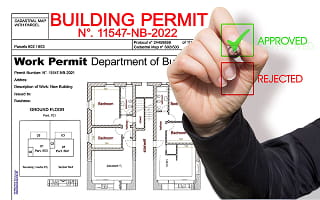
Permits are required for most new construction and renovation, remodeling, repair, or home improvement projects in New Haven. These permits are issued by the New Haven Office of Building Inspection & Enforcement. Work that does not change or alter a building's structure or core systems, such as painting, papering, tiling, carpeting, installing cabinets or countertops, and other similar finish work, is usually exempt. You can use the office's City Squared platform to apply for permits, submit plans, and pay fees (account registration may be required). You can also visit Room 501, 200 Orange St., New Haven, CT 06510 for in-person assistance or call (203) 946-8045 for general inquiries.
Common types of permits issued in New Haven include:
-
Building Permits: For constructing new buildings and structurally altering existing ones.
-
Electrical Permits: For installing new wiring, upgrading panel upgrades, and other modifications to electrical systems.
-
Plumbing Permits: For installing, replacing, or modifying piping, drainage, sewer lines, and other plumbing systems.
-
HVAC Permits: For installing, replacing, or modifying heating, ventilation, air conditioning, and other mechanical systems.
When applying for any of these permits, you must submit the proper documentation (building plans, blueprints, contractor licenses, materials lists, etc.). You must also pay the appropriate fee.
Building inspections are part of the permit process, and they ensure that the work complies with local building and safety codes. You can schedule an inspection through the online portal or in person at the office during regular business hours.
Real Estate in the City of New Haven

Located on the northern shore of Long Island Sound, New Haven is the anchor city of the South Central Connecticut Planning Region and one of the state's oldest, most historically significant communities. Established in 1638 as one of the first planned cities in the United States, New Haven has grown into a major regional cultural, educational, and medical hub, offering a mix of vibrant urban life and quiet residential neighborhoods. The city is famously known as the home of Yale University, one of the nation's oldest and most prestigious institutions of higher learning. Beyond academia, New Haven is celebrated for its world-class museums, the historic New Haven Green, and its legendary culinary scene, particularly its distinctive New Haven-style thin-crust pizza. The city also boasts attractions like the Shubert Theatre, East Rock Park, and the Westville Music Bowl.
New Haven, Connecticut, has a population of 134,023 residents, with 61,203 housing units: roughly 92% of these units are occupied, and 30% are owner-occupied. There is a diverse housing stock, which includes single-family homes, duplexes and "triple-decker" multi-family homes, condos, modern downtown lofts, and student housing, with common housing styles like Colonial, Cape Cod, Greek Revival, Tudor, Queen Anne, Federal, and Mid-Century Modern. The average home value in New Haven, CT, is $317,708, representing a 4.6% increase from previous years. Note that actual prices can vary significantly depending on the neighborhood. Here are some examples:
- Dixwell $314,946
- Downtown $365,661
- Dwight $184,177
- East Rock $590,822
- Hill $284,580
- Prospect Hill $520,069
- Wooster Square $395,770
The New Haven, Connecticut, real estate market is moderately competitive, generally marked by low inventory and steady appreciation. It attracts a mix of first-time homebuyers, academic professionals, and investors drawn to the city's consistent rental demand. On average, homes go under contract in 37 days, and nearly 49% of properties sell above the initial asking price.
Searching across multiple government offices and databases to piece together a complete property profile can be time-consuming, but PropertyChecker simplifies the process by pulling key ownership details, tax records, transaction histories, and more into a single, easy-to-use platform. Whether you are buying, investing, or simply doing your due diligence, visit PropertyChecker.com to get the property information you need in minutes.